


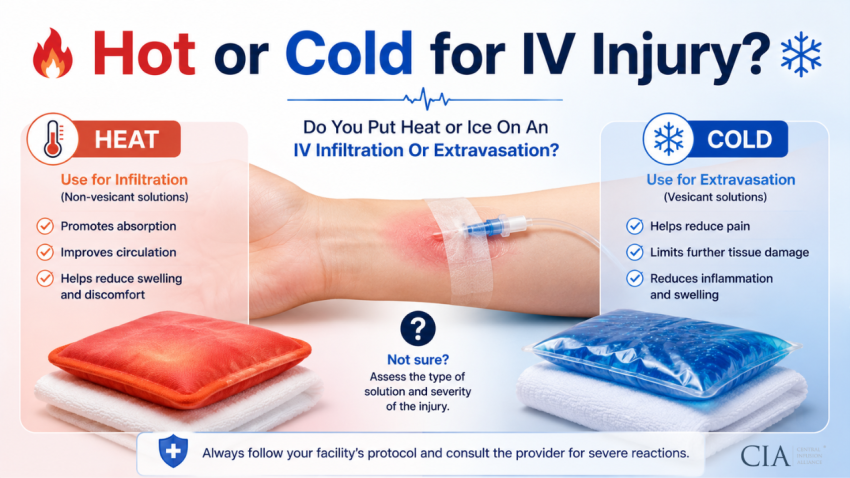
Do You Apply Heat or Cold On An IV Infiltration Or Extravasation?
The answer depends entirely on what leaked and what caused it. IV infiltration and extravasation are not the same injury, and the thermal management for each is not interchangeable.
Applying cold to a vinca alkaloid extravasation will worsen tissue necrosis. Applying heat to an anthracycline extravasation will increase the drug’s tissue-damaging activity and accelerate cell death. Getting this wrong does real harm. This page covers the thermal management rules, the pharmacological antidotes, and the step-by-step response protocol for both infiltration and extravasation.
What Is the Difference Between IV Infiltration and Extravasation?
These two terms are frequently used interchangeably in practice, but they describe different events with different clinical implications.
Infiltration is the unintentional administration of a non-vesicant solution or medication into the surrounding tissue. The cannula has dislodged or the vein wall has been breached, and fluid that cannot cause permanent tissue damage is now infusing into the interstitial space. Saline, dextrose solutions, and most maintenance IV fluids cause infiltration when they leak. The injury is primarily mechanical, swelling, pain, coolness to touch, and slowed or stopped infusion flow.
Extravasation is the unintentional leakage of a vesicant, a substance capable of causing tissue injury, blistering, ulceration, or necrosis. Chemotherapy agents (particularly anthracyclines and vinca alkaloids), hypertonic solutions, vasopressors (norepinephrine, dopamine), calcium gluconate, potassium chloride, and sodium bicarbonate at high concentrations are all vesicants. Extravasation can produce severe, progressive tissue injury, sometimes requiring surgical debridement or skin grafting if not managed promptly.
The distinction matters because the treatment protocols diverge sharply. Non-vesicant infiltration is managed conservatively. Vesicant extravasation is a medical emergency requiring drug-specific interventions.
Does Heat or Ice Help with IV Infiltration (Non-Vesicant)?
For non-vesicant infiltration, a warm compress is the standard recommendation. Warmth promotes local vasodilation, improving blood flow to the affected area and accelerating reabsorption of the infiltrated fluid into the systemic circulation. This reduces swelling, minimizes pain, and supports tissue recovery.
The typical protocol: apply a warm compress for 20 minutes, four times per day, until swelling resolves. The compress should be warm, not hot. Temperatures above approximately 40 to 42 degrees Celsius can cause burns, particularly in patients with compromised sensation, neonates, or those with thin skin from corticosteroid use or aging.
Elevation of the affected limb complements warmth by using gravity to reduce interstitial fluid accumulation and promote lymphatic drainage. Most non-vesicant infiltrations resolve within 24 to 48 hours with warm compresses and elevation, provided the infusion is stopped and the cannula removed promptly.
There is no clinical indication for cold application in non-vesicant infiltration. Cold causes vasoconstriction, which slows, rather than promotes, reabsorption of the infiltrated fluid.
Does Heat or Ice Help with IV Extravasation (Vesicant)?
For vesicant extravasation, the thermal management decision is not a simple warm-or-cold choice, it is drug-specific. The correct answer for anthracyclines is cold. The correct answer for vinca alkaloids is warm. Using the wrong one can significantly worsen the injury.
Before applying any thermal treatment, identify the extravasated drug and consult your facility’s extravasation protocol or pharmacy. If the drug cannot be identified, do not apply heat or cold until it can be.
Which Extravasation Injuries Require Cold Compresses?
Cold compresses (ice packs or cold gel packs) are indicated for extravasation from anthracyclines and several other DNA-binding agents:
- Anthracyclines: doxorubicin (Adriamycin), daunorubicin, epirubicin, idarubicin. Apply ice or a cold compress for 15 to 20 minutes, four times per day, for 1 to 2 days following the extravasation.
- Alkylating agents: mechlorethamine (nitrogen mustard), cold compress reduces local drug activity.
- Platinum compounds: cisplatin at high concentrations, cold limits local spread.
The rationale for cold in these cases is pharmacological: low temperature reduces local enzymatic activity, slowing the rate at which these DNA-intercalating drugs damage cells. Cold also promotes vasoconstriction, which limits drug diffusion away from the initial extravasation site, essentially containing the injury to a smaller area. This is particularly important for doxorubicin, which causes progressive, expanding necrosis through a free-radical-mediated mechanism that continues even after infusion stops.
Cold packs should not be applied directly to skin. Wrap in a cloth or use a commercially available cold pack designed for skin application. Document the application time.
Which Extravasation Injuries Require Warm Compresses?
Warm compresses are specifically required, and cold is specifically contraindicated, for vinca alkaloid extravasation:
- Vinca alkaloids: vincristine, vinblastine, vinorelbine, vindesine
- Some taxane protocols (consult oncology pharmacy for your facility’s specific guidance)
For vinca alkaloid extravasation, warmth promotes local vasodilation and dispersal of the drug away from the extravasation site into the surrounding tissue and lymphatic system, reducing the concentration at any one site and minimizing focal necrosis.
Applying cold to vinca alkaloid extravasation has the opposite effect: it concentrates the drug at the extravasation site by causing vasoconstriction that prevents dispersal. This markedly worsens tissue injury and the resulting necrosis. This is one of the clearest contraindication rules in extravasation management, never apply cold to a vinca alkaloid extravasation.
Warm compresses for vinca alkaloids: apply for 20 minutes, four times per day, for 1 to 2 days. Temperature should be comfortably warm, not hot.
What Are the Antidotes for Extravasation?
Several pharmacological antidotes have established or FDA-approved roles in extravasation management:
Dexrazoxane (Totect) for Anthracycline Extravasation
Dexrazoxane is the only FDA-approved systemic antidote for anthracycline extravasation. It works by displacing anthracyclines from DNA-topoisomerase II complexes and acts as a free-radical scavenger, interrupting the cell-death cascade at the tissue level.
Administration: dexrazoxane must be given intravenously within 6 hours of extravasation detection. The standard regimen is once daily for 3 consecutive days, dosed at 1,000 mg/m2 on days 1 and 2, and 500 mg/m2 on day 3, infused over 1 to 2 hours each day. DMSO (dimethyl sulfoxide) should NOT be used concurrently with dexrazoxane, it reduces its effectiveness.
Delay in initiating dexrazoxane beyond 6 hours significantly reduces its efficacy. Early identification and escalation are essential.
Hyaluronidase for Vinca Alkaloid and Other Extravasations
Hyaluronidase is an enzyme that degrades hyaluronic acid in the extracellular matrix, facilitating drug dispersal and reabsorption. It is used to manage extravasation from vinca alkaloids, taxanes, and other non-anthracycline agents where dispersal (rather than localization) is the goal.
Standard dosing: 150 to 300 units subcutaneously, injected in multiple small aliquots (typically 0.1 to 0.2 mL per injection) clockwise around the perimeter of the extravasation site, as soon as possible after extravasation is detected. Warm compresses should be applied following hyaluronidase injection.
Sodium Thiosulfate for Mechlorethamine and Cisplatin Extravasation
Sodium thiosulfate neutralizes the DNA-alkylating activity of mechlorethamine (nitrogen mustard) through a chemical reaction that converts the drug to a less toxic metabolite. It is administered both topically and subcutaneously around the extravasation site. For mechlorethamine, a 1/6 molar solution (4 mL sodium thiosulfate 10% + 6 mL sterile water) is injected around the area. Topical application of DMSO has also been used for cisplatin extravasation, though the evidence base is weaker than for dexrazoxane in anthracycline injuries.
What Are the Steps for Managing an IV Infiltration or Extravasation?
- Stop the infusion immediately. Do not remove the cannula yet.
- Aspirate: using the existing cannula, aspirate as much of the extravasated fluid as possible through the cannula before removing it. Do not flush the line.
- Remove the cannula, after aspiration is complete or yields nothing further.
- Estimate the volume extravasated and identify the drug. Both are needed for documentation and to determine antidote dosing.
- Mark the perimeter of the affected area with a skin marker pen. This allows serial assessment of whether the area is expanding or resolving.
- Apply the appropriate thermal treatment based on the drug class (cold for anthracyclines and alkylating agents; warm for vinca alkaloids and non-vesicant infiltration).
- Administer pharmacological antidote if indicated. For anthracycline extravasation, contact oncology or pharmacy immediately to initiate dexrazoxane within the 6-hour window.
- Elevate the affected extremity above heart level.
- Reassess the site every 15 to 30 minutes initially, then hourly. Look for expansion of the affected area, blistering, skin color changes (blanching or darkening), and patient-reported pain levels.
- Notify the physician and consider plastic surgery or wound care consultation for large-volume vesicant extravasation, any extravasation with visible tissue blanching or blistering, or lack of improvement within 24 hours.
- Document fully (see below) and initiate follow-up per facility protocol.
How Should Extravasation Be Documented?
Thorough documentation is both a clinical and medicolegal requirement. The extravasation event record should include:
- Date and time the extravasation was detected
- Anatomical location of the IV site and description of the affected area (size in centimeters, appearance, skin integrity)
- Signs and symptoms at the time of detection: swelling, redness, blanching, pain score, blistering
- Drug name, concentration, and estimated volume extravasated
- Time the infusion was stopped
- Volume aspirated through the cannula before removal
- Thermal treatment applied: type (warm/cold), duration, frequency
- Pharmacological antidotes administered: drug name, dose, route, time, and who administered
- Physician notification: time, name, and instructions given
- Patient education provided: explanation of event, signs to report, follow-up instructions
- Reassessment findings at each subsequent check
Many facilities use a standardized extravasation incident form that captures all required fields. Where no standard form exists, document in the nursing notes in a structured format covering each of the above elements. Complete documentation protects both the patient and the clinician.
References
- https://ascopubs.org/doi/10.1200/OP-25-00579
- https://pmc.ncbi.nlm.nih.gov/articles/PMC2697522/
- https://pmc.ncbi.nlm.nih.gov/articles/PMC4734939/
- https://pmc.ncbi.nlm.nih.gov/articles/PMC7431942/
- https://pmc.ncbi.nlm.nih.gov/articles/PMC5977944/
- https://www.accessdata.fda.gov/drugsatfda_docs/label/2009/022025s001lbl.pdf
- https://www.eviq.org.au/clinical-resources/extravasation/157-extravasation-management
- https://dig.pharmacy.uic.edu/faqs/2021-2/february-2021-faqs/what-are-current-recommendations-for-treatment-of-drug-extravasation/
- https://www.mdanderson.org/content/dam/mdanderson/documents/for-physicians/algorithms/clinical-management/clin-management-extravasation-web-algorithm.pdf

