


How Long Does It Take for a 500 mL IV Drip Saline Bag to Empty?
A 500 mL bag of normal saline, lactated Ringer’s, or other isotonic IV fluid is among the most common infusion volumes in clinical practice. How long it takes to run depends entirely on the ordered flow rate, or, for gravity infusions, the calculated drip rate.
The answer ranges from under 2.5 hours at 200 mL/hr to 10 hours at a conservative 50 mL/hr. Knowing these numbers precisely matters for scheduling bag changes, timing concurrent medications, and ensuring ordered rates are actually running as prescribed.
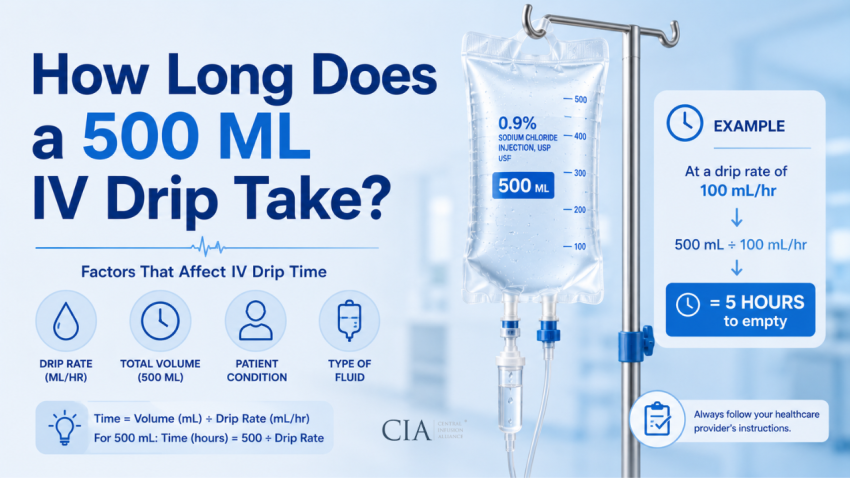
What Is the Formula for IV Drip Infusion Time?
The basic formula for infusion time is straightforward:
Infusion Time (hours) = Volume (mL) / Flow Rate (mL/hr)
For a 500 mL bag: Time = 500 / Flow Rate.
This gives infusion time in decimal hours. To convert the decimal portion to minutes, multiply by 60. For example, 500 / 75 = 6.67 hours, which equals 6 hours and 40 minutes (0.67 x 60 = 40 minutes).
This formula assumes a constant, uninterrupted flow at the programmed rate. Real-world factors, occlusion alarms, patient repositioning, line flushes, and pump pauses, mean actual elapsed time is often longer than calculated.
How Long Does a 500 mL Bag Take at Common Flow Rates?
The table below shows infusion duration at clinically common flow rates, with context for each:
| Flow Rate (mL/hr) | Infusion Time | Clinical Context |
| 50 mL/hr | 10 hours | Slow maintenance, fluid-restricted patients (CHF, CKD) |
| 75 mL/hr | ~6.7 hours | Moderate maintenance, post-op patients with some restriction |
| 83 mL/hr | ~6 hours | Common maintenance rate (equivalent to ~2 L/day) |
| 100 mL/hr | 5 hours | Standard adult hydration maintenance |
| 125 mL/hr | 4 hours | Rehydration for mild-to-moderate dehydration |
| 150 mL/hr | ~3.3 hours | Faster rehydration, fever-related fluid deficits |
| 200 mL/hr | 2.5 hours | Rapid infusion, pre-procedure hydration |
How Do You Calculate Drip Rate for a 500 mL Bag Without a Pump?
Gravity infusions require manual calculation of the drip rate in drops per minute (gtt/min). The formula is:
gtt/min = (Volume in mL x Drop Factor) / Time in minutes
Drop factor is specific to the IV set being used and is printed on the packaging. Standard macrodrip sets deliver 10 or 15 gtt/mL. Microdrip sets deliver 60 gtt/mL and are used when precise low-rate infusions are needed without a pump.
Example: 10 gtt/mL Set (Macrodrip)
To infuse 500 mL over 4 hours: 500 x 10 / 240 minutes = 20.8, rounded to 21 gtt/min.
To infuse 500 mL over 8 hours: 500 x 10 / 480 minutes = 10.4, rounded to 10 gtt/min.
Example: 15 gtt/mL Set (Macrodrip)
To infuse 500 mL over 4 hours: 500 x 15 / 240 minutes = 31.25, rounded to 31 gtt/min.
To infuse 500 mL over 8 hours: 500 x 15 / 480 minutes = 15.6, rounded to 16 gtt/min.
Example: 60 gtt/mL Set (Microdrip)
To infuse 500 mL over 8 hours: 500 x 60 / 480 minutes = 62.5, rounded to 63 gtt/min.
To infuse 500 mL over 10 hours: 500 x 60 / 600 minutes = 50 gtt/min.
A useful shortcut with 60 gtt/mL sets: the drip rate in gtt/min numerically equals the flow rate in mL/hr. If the ordered rate is 50 mL/hr, set the drip to 50 gtt/min.
What Factors Can Change How Long a 500 mL Bag Actually Takes?
Even with a correct calculation, actual infusion time often deviates from the theoretical value. Key variables include:
- Pump accuracy tolerance: Most volumetric infusion pumps are accurate to within +/- 5% under ideal conditions, meaning a calculated 5-hour bag could realistically run between 4 hours 45 minutes and 5 hours 15 minutes.
- Occlusion alarms and pump pauses: Any interruption adds to total elapsed time. Document the reason and update the expected completion time.
- Position changes: For gravity drips, patient arm position directly affects venous pressure and flow rate. Raising the arm reduces the hydrostatic driving pressure; lowering it increases it.
- Filter use: In-line filters add resistance to the circuit, slightly slowing gravity infusions. Most filters are rated for specific flow rates; high-resistance filters can reduce flow more substantially.
- Tubing kinks and partial occlusions: A kink in the IV tubing is the most common non-patient reason for a bag running slower than expected. Regular line checks are essential.
- Bag height: For gravity infusions, the standard recommendation is 36 inches (approximately 91 cm) above the IV site. Lower bag placement slows infusion; this is sometimes used intentionally to extend infusion time.
When Should You Hang a New Bag Before the 500 mL Runs Out?
Do not wait for the bag to run completely dry. Most IV pumps will alarm at air-in-line or end-of-infusion before the bag is truly empty, but relying on the alarm as the sole trigger risks allowing a brief dry period that introduces air into the tubing.
A practical approach: anticipate bag completion by checking the remaining volume at regular nursing rounds. For continuous infusions, prepare and spike the next bag before the current one drops below 50 to 100 mL. This is especially important for medications where flow interruption matters, vasopressors, insulin drips, heparin infusions, where even a brief gap can affect hemodynamic stability or anticoagulation levels.
For routine hydration, the Joint Commission and most facility policies require IV site and infusion assessment at least every 1 to 2 hours; this interval should naturally catch a near-empty bag.
What Are the Most Common Uses for a 500 mL Saline Bag?
The 500 mL bag is widely used across clinical settings where the full 1,000 mL volume is unnecessary or would take too long at the ordered rate. Common applications include:
- Fluid-restricted patients: Patients with CHF, CKD, or hepatic failure often have fluid restrictions of 1,000 to 1,500 mL/day. Using a 500 mL bag reduces the risk of inadvertent overload if monitoring lapses.
- Medication diluent: Many IV antibiotics, electrolyte replacements (potassium, magnesium), and antifungals are diluted in 100 to 500 mL for administration. The 500 mL bag allows precise dosing concentration.
- Pre- and post-procedure hydration: Contrast nephropathy prophylaxis protocols often use 500 mL normal saline at 100 mL/hr before and after CT contrast administration.
- Pediatric patients: When a full 1,000 mL bag creates programming risk (e.g., accidental free-flow delivery), a 500 mL bag limits potential volume exposure.
- Short-course infusions: For drugs infused over 1 to 4 hours, a 500 mL bag at higher rates keeps infusion time manageable.
References
- https://www.ncbi.nlm.nih.gov/books/NBK596732/
- https://www.ncbi.nlm.nih.gov/books/NBK596734/
- https://pmc.ncbi.nlm.nih.gov/articles/PMC11277838/
- https://pmc.ncbi.nlm.nih.gov/articles/PMC11641750/
- https://pubs.rsna.org/doi/10.1148/radiol.2019192094
- https://link.springer.com/article/10.1007/bf03015239
- https://journals.sagepub.com/doi/10.1177/20420986231188602
- https://www.nice.org.uk/guidance/cg174/chapter/recommendations
- https://www.fda.gov/medical-devices/infusion-pumps/examples-reported-infusion-pump-problems

