


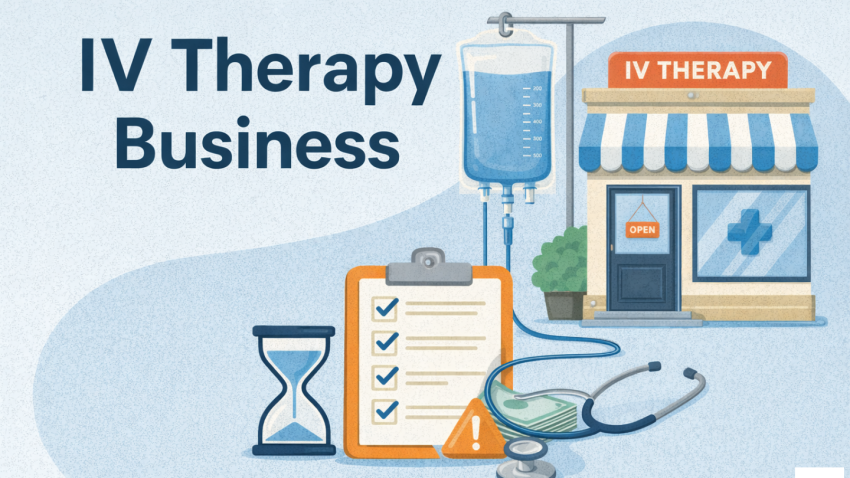
How to Start an IV Therapy Business & What Equipment is Needed?
The IV therapy industry is growing fast. In 2022, the US market brought in around $941 million. By 2024, that number had climbed to $2.1 billion. More people are paying out of pocket to feel better, recover faster, and get nutrients straight into their bloodstream. For healthcare professionals and entrepreneurs alike, this growth has opened a real business opportunity.
But starting an IV therapy business is not as simple as buying some saline bags and setting up a recliner chair. There are licenses to get, equipment to source, staff to hire, and regulations to follow at every level of government. This guide walks you through everything you need to know, from the first legal steps to the last piece of equipment in your supply kit.
Understanding the IV therapy business model
An IV therapy business delivers fluids, vitamins, minerals, and sometimes medications directly into a client’s bloodstream through an intravenous line. Because the treatment bypasses the digestive system entirely, absorption is faster and more complete than swallowing a supplement. Clients come in for hydration after a long flight, vitamin boosts before a big event, hangover recovery, athletic performance support, immune system support, or just general wellness. The service typically takes 30 to 60 minutes.
You have two main formats to choose from. The first is a fixed clinic, sometimes called an IV lounge or IV bar. This gives you more space, a stronger brand presence, and the ability to see several clients at once. Startup costs for a fixed location typically run between $100,000 and $200,000.
The second option is a mobile service, where a clinician travels to the client’s home, hotel room, office, or event. Mobile operations cost significantly less to launch, usually between $50,000 and $100,000, because you skip the cost of leasing and renovating a physical space.
Some owners run both. They start mobile to keep costs low, build a client base, and then open a physical location once revenue is stable. Neither model is better on its own. The right choice depends on your local market, your budget, and the type of experience you want to deliver.
Revenue and profit potential
The average IV hydration session in the US costs around $280, though prices range from $100 for a basic saline drip to $400 or more for premium custom formulations. A solo mobile practitioner seeing two clients per day, six days a week, can bring in roughly $175,000 per year. With an industry margin of around 35 percent, that works out to about $61,000 in profit. A full-service clinic running four to five sessions a day can approach $400,000 in annual revenue, with estimated profit closer to $140,000.
Revenue is not limited to IV drips alone. You can add intramuscular (IM) injections for things like B12 or vitamin D, retail sales of oral supplements, memberships, package deals, and corporate wellness partnerships. These add-ons raise the average transaction value without requiring much additional overhead. The key metric to watch is nurse utilization. Your licensed staff can only do so many treatments per day, so filling their schedule efficiently is the most direct path to profitability.
Legal structure and business registration
Before anything else, you need to set up a legal business entity. Most IV therapy business owners choose a Limited Liability Company (LLC) because it is straightforward to form, protects your personal assets from business liability, and is flexible for tax purposes. In some states, if the business will be owned and operated by a licensed physician, you may need to form a Professional LLC (PLLC) or a professional corporation instead.
Once your entity is formed, register your business with your city or county to get a general business license. This typically costs between $50 and $300. You will also need to obtain an Employer Identification Number (EIN) from the IRS if you plan to hire staff or open a business bank account. Keeping personal and business finances separate from day one protects you legally and makes tax time considerably simpler.
State licensing and regulatory requirements
This is where many new IV therapy business owners get tripped up. The rules are not uniform across the country. Each state has its own laws about who can own an IV therapy clinic, who can administer IV treatments, and what oversight structures must be in place. Getting this wrong can mean fines, license revocation, or worse.
Corporate practice of medicine rules
Many states follow what is called the corporate practice of medicine doctrine. This limits or prohibits non-physician entities from owning a medical practice. California, for example, requires that a licensed physician own at least 51 percent of an IV therapy clinic. Other states, like Florida, do not have this ownership restriction, which makes it easier for non-clinical entrepreneurs to operate. Before you form your entity, research your state’s rules carefully. A healthcare attorney familiar with your state’s laws is worth every penny at this stage.
Healthcare facility licenses and health department permits
Depending on your state, you may need an outpatient clinic license, a healthcare facility license, or a specific ambulatory care permit in addition to your basic business license. Some states require registration with the state health department, and others require inspections before you can open. Virginia, for instance, requires that businesses offering home IV infusion services obtain a Home Care Organization license from the Virginia Department of Health. Contact your state health department directly and ask specifically about IV therapy or infusion therapy clinics.
HIPAA and CMS compliance
As a medical business, you must comply with the Health Insurance Portability and Accountability Act (HIPAA). This means protecting client health information through secure electronic record systems, staff training on privacy practices, and proper documentation protocols. The Centers for Medicare and Medicaid Services (CMS) also sets standards that apply to many outpatient clinical settings. Even if you do not bill Medicare or Medicaid, CMS standards often serve as the baseline expectation regulators and insurers use when evaluating clinical practices.
DEA registration and pharmacy considerations
If your treatments involve only standard IV fluids and water-soluble vitamins, you generally do not need DEA registration. However, if you plan to administer controlled substances, such as certain anti-nausea medications or sedatives, you will need to register with the Drug Enforcement Administration and possibly obtain a pharmacy license. Be clear about your service menu before you sort out your licensing, because the medications you plan to offer determine which additional permits apply to you.
OSHA bloodborne pathogens requirements
The Occupational Safety and Health Administration requires all staff who handle IV equipment or who may come into contact with blood to complete bloodborne pathogens training. You must have proper sharps disposal systems in place, personal protective equipment available at all treatment stations, and a written exposure control plan. For mobile operations, this extends to every environment your team works in, whether that is a client’s living room, a hotel suite, or an outdoor event space.
The medical director requirement
In most states, an IV therapy business must have a licensed physician serving as its medical director. This is not a formality. The medical director provides clinical oversight, reviews and signs treatment protocols and standing orders, is available for consultations when clinical questions arise, audits records on a regular schedule, and is responsible for risk management. The physician does not need to be on-site for every treatment, but must be reachable when needed.
When hiring a medical director, look for a board-certified MD or DO with a background in emergency medicine, internal medicine, or anesthesiology. They should hold an active license in every state where you plan to operate, have experience with IV micronutrient therapy, and be comfortable using telehealth platforms for remote consultations. Contracts for medical director services typically range from a few hundred to several thousand dollars per month depending on the scope of oversight, the state, and the volume of patients you serve.
Qualified staff and scope of practice
The person inserting an IV line and administering the infusion must hold the appropriate clinical license. In most states, this means a Registered Nurse (RN), Nurse Practitioner (NP), Physician Assistant (PA), Licensed Practical Nurse (LPN), or Licensed Vocational Nurse (LVN). Some states also allow paramedics to administer IV therapy under direct physician supervision. The specifics vary, so verify what is allowed in your state before making hiring decisions.
In all states, a licensed healthcare provider must conduct a good-faith exam before a client’s first treatment. This exam confirms that IV therapy is appropriate for the individual. Some states require only a physician or NP to conduct this exam, even if an RN will administer the treatment. Many clinics conduct good-faith exams via telehealth to handle this requirement efficiently without adding too much friction to the client experience.
Beyond your clinical staff, you will likely need front-of-house support. A receptionist, a practice manager, and eventually a marketing hire all contribute to how smoothly the business runs and how effectively it grows. All staff, clinical or otherwise, should receive training on your safety protocols, patient privacy requirements, and emergency response procedures.
Writing your business plan
A business plan is not something you write once and file away. It is a working document that forces you to think through every part of your operation before you spend a dollar. A solid IV therapy business plan covers your executive summary, a description of your services and pricing, a market and competitive analysis, your marketing and sales strategy, your management team and staffing plan, and your financial projections.
On the financial side, build out three scenarios: a conservative one with two or three clients per day at a $200 average, a realistic one with four or five clients per day at $250, and an optimistic one with six to eight clients per day at $300. Map out your startup costs, your monthly fixed overhead, and your break-even point. Lenders and investors look at these numbers carefully, so make every assumption defensible with real market data.
Part of your planning should also address your standard operating procedures, often called SOPs. These written protocols cover every clinical and operational process in your business, from how a client intake form is handled to the exact steps for IV insertion, infusion monitoring, and post-treatment documentation. Well-written SOPs protect your clients, protect your staff, and protect your business if you ever face a legal challenge.
Choosing your location
If you are opening a fixed clinic, location matters. Look for a space with good foot traffic, easy parking, and proximity to complementary services such as gyms, wellness centers, yoga studios, or medical offices. The space should be large enough for a reception area, at least two or three private or semi-private treatment rooms, a supply storage area, and a small staff workspace. Most IV lounges operate comfortably in 1,000 to 2,500 square feet.
When evaluating a space, confirm that the layout can be configured to meet ADA accessibility requirements and that it has adequate ventilation, plumbing, and electrical capacity for your equipment. Minimize renovation costs by choosing a space that already has the bones you need. A former medical office or wellness suite often needs far less work than a raw retail space.
For mobile operations, a van or SUV typically serves as your mobile unit. The vehicle needs to be clean, organized, and equipped with all the supplies and safety equipment your team needs for each call. Some mobile operators customize cargo vans with shelving, a small refrigeration unit, and a designated sharps disposal station. Whatever vehicle you use, it must meet any state regulations for mobile healthcare providers, and your team needs to work safely in varied environments, from high-rise apartments to outdoor festival grounds.
Equipment needed to run an IV therapy business
Getting your equipment right is one of the most important investments you will make. Every item must be medical-grade, sourced from a reputable supplier, and kept in proper condition. Below is a breakdown of the core equipment categories your business needs.
IV administration equipment
The core of every treatment is the IV setup itself. You will need IV catheters in multiple gauges to accommodate different patients and vein conditions. IV fluid bags in standard volumes (typically 250 mL, 500 mL, and 1,000 mL) hold your saline, lactated Ringer’s solution, or compounded nutrient mixtures. IV tubing connects the bag to the catheter and must be sterile, single-use, and compatible with your pumps and flow control devices. IV poles or stands hold the fluid bags at the correct height during infusion, and you will need enough of them to run multiple treatment stations simultaneously. Infusion pumps give you precise control over drip rates, which is important for maintaining consistent, safe treatments, especially when administering vitamins or other additives.
Needles, syringes, and access supplies
You will need a consistent supply of sterile needles and syringes in various sizes for drawing up additives and for intramuscular injections if you offer them. Tourniquet bands help distend veins before catheter insertion. Transparent IV dressing and medical tape secure the catheter site and keep it sterile throughout the infusion. Alcohol swabs and antiseptic wipes are used to clean the insertion site before every needle stick, and chlorhexidine-based prep pads offer a more thorough antiseptic prep for clients whose veins are harder to access.
Monitoring and safety equipment
Patient safety requires active monitoring throughout every treatment. A blood pressure monitor and pulse oximeter allow your clinician to track vital signs before, during, and after the infusion. A thermometer enables quick temperature checks if a client reports feeling unwell. Stethoscopes should be available for any clinician who needs to perform a brief physical assessment. A height-and-weight scale is useful during intake to help calculate appropriate dosing for certain nutrients or medications.
Emergency preparedness is non-negotiable. Every treatment location, whether fixed or mobile, must have an emergency supply kit that includes at minimum epinephrine (for anaphylaxis), antihistamines, oxygen if your medical director requires it, and a protocol for calling emergency services. All clinical staff must be current in CPR and basic life support training.
Personal protective equipment (PPE)
Your clinical staff must wear nitrile or latex-free gloves for every IV insertion and every time they handle an open needle. Disposable gloves must be changed between patients without exception. Medical masks, eye protection, and disposable gowns or aprons should be available whenever there is a risk of blood or fluid exposure. PPE is not a cost to minimize. It protects your staff, protects your clients from cross-contamination, and is required under OSHA’s bloodborne pathogens standard.
Sharps disposal and medical waste management
Every used needle, catheter, and lancet must go directly into an approved sharps container. Never place them in regular trash. Sharps containers must be puncture-resistant, leak-proof, and properly labeled. Once full, they must be disposed of through a licensed medical waste hauler or a mail-back sharps disposal program. For mobile operations, you will need portable sharps containers that can travel safely between locations. Failure to properly manage sharps waste is a regulatory violation that can result in serious penalties.
Preparation and compounding area
If you prepare custom IV formulations on-site, you need a dedicated, clean preparation area. This space must be free of dust and contaminants, well-lit, and stocked with all the tools needed to add vitamins and minerals to IV bags under sterile conditions. Some clinics use a laminar flow hood, a piece of equipment that uses filtered air to maintain a sterile environment during preparation. If you are adding more than one or two ingredients to a bag, proper sterile compounding technique is critical for patient safety.
Refrigeration units are needed to store temperature-sensitive vitamins and medications at the correct temperature. A dedicated medical-grade refrigerator, separate from any food storage, is the right approach. Labeling all stored supplies with dates and contents keeps your inventory organized and ensures nothing is used past its safe shelf life.
Clinical intake and documentation tools
Every client visit must be documented. You need a system for collecting intake forms, health history, signed consent forms, treatment notes, and post-care instructions. Practice management software designed for medical spas or IV therapy clinics handles scheduling, patient records, billing, and digital consent forms in one place. A paperless system is especially important for mobile operations, where carrying paper files is impractical and protecting them from damage or loss is difficult.
Clinic furniture and treatment room setup
The physical environment your clients sit in matters more than many new owners expect. Comfortable reclining chairs or treatment chairs are the centerpiece of each station. Clients spend 30 to 60 minutes in these chairs, so comfort is a direct part of the experience. Side tables or IV tray stands hold supplies within arm’s reach of the clinician without cluttering the space. Adequate lighting is important for accurate vein assessment and safe catheter insertion. Good lighting reduces the risk of insertion complications, which protects both the client and your liability exposure.
The reception area should feel clean, calm, and professional. A front desk with a computer and a booking system, comfortable seating for waiting clients, and clear signage that communicates your services all contribute to a first impression that builds trust. If you have the budget, ambient features such as soft music, subdued lighting, and a clean, consistent color scheme reinforce the premium positioning that justifies your price point.
Sourcing your medical supplies
Where you buy your supplies matters as much as what you buy. All IV fluids, catheters, tubing, needles, and other clinical supplies must come from licensed, reputable medical distributors. Using gray-market or uncertified products is a regulatory violation and a genuine patient safety risk. Quality medical distributors carry products from established manufacturers, can provide documentation of proper storage and cold-chain handling, and offer reliable restocking timelines so you are never caught short.
Opening accounts with more than one supplier is a smart risk management move. Supply shortages happen. Having two or three approved vendor relationships means that when one supplier is temporarily out of a product, your business does not stop running. For vitamins and compounded additives, work only with FDA-registered 503A or 503B compounding pharmacies to ensure sterility and proper labeling.
Wholesale medical supply distributors like CIA Medical offer broad product catalogs from thousands of manufacturers, volume pricing, and the kind of supply consistency that a growing clinic depends on. As your patient volume increases, buying in larger quantities reduces your cost per treatment and improves your margins. Track your inventory turnover and stock-out frequency so you always know how much lead time you need to reorder each item.
Insurance coverage you need
IV therapy is a medical service, and that means your insurance needs go beyond what a typical small business carries. You need at least two types of coverage from day one. The first is professional liability insurance, also called malpractice insurance. This protects you and your staff if a client suffers harm and files a claim against your business. Annual premiums typically run between $5,000 and $15,000 depending on your location, the number of clinicians on staff, and your patient volume.
The second is general liability insurance, which covers property damage, slip-and-fall incidents, and other non-clinical accidents that happen on your premises or during mobile calls. If you operate from a vehicle, commercial auto insurance with appropriate medical cargo coverage is also required. Some states may require additional coverage types as a condition of your facility license or medical director agreement, so check the specifics for your state before finalizing your policies.
Marketing your IV therapy business
You can have the best clinical team and the finest supplies in the city and still fail if no one knows you exist. Marketing is not optional. IV therapy is still a relatively new concept for many potential clients, which means your marketing needs to both attract attention and explain the value of the service.
A professional website with easy online booking is your most important marketing asset. Optimize it for search terms your clients actually use, such as “IV hydration near me,” “vitamin drip [your city],” or “hangover IV treatment.” Claim and fully complete your Google Business Profile so your clinic appears in local map searches. Post regularly to Instagram and other social platforms where your target demographic spends time. Before-and-after testimonials, behind-the-scenes clinic content, and educational posts about the benefits of specific drip formulations all perform well on these channels.
Local partnerships are often overlooked but consistently produce results. Reach out to gyms, CrossFit boxes, sports teams, yoga studios, and corporate wellness programs. Offering to sponsor an event or provide on-site IV services at a race finish line gets your brand in front of your exact target client. Membership plans and package deals build loyalty and create recurring revenue. A client who pre-purchases six sessions is far more likely to return and refer friends than one who walks in with no prior commitment.
Managing your operations day to day
Clean operations are what separate businesses that grow from businesses that stumble. Every appointment should follow the same intake, assessment, preparation, administration, and post-care documentation sequence. Deviating from your SOPs, even occasionally, increases clinical risk and makes it harder to identify problems when they arise.
Track your key operational metrics every week: appointments booked, appointments completed, revenue per appointment, no-show rate, and supply costs as a percentage of revenue. These numbers tell you where your business is healthy and where it needs attention. If your supply costs are creeping up without a corresponding increase in revenue, you likely have a waste or inventory management problem. If your no-show rate is high, your booking confirmation process needs work.
Staff scheduling is directly tied to your revenue capacity. Your RNs and NPs are your revenue constraint. Every hour they are not treating a client is revenue you did not earn. Build schedules that maximize their productive hours without burning them out, because clinical errors increase with fatigue. Cross-train your support staff where possible so that a single absence does not break your daily operations.
Getting your first clients through the door
A soft opening with a small group of invited guests, friends, or local influencers in your target market gives your team a chance to run through the full client experience in a lower-pressure setting. It also generates your first round of testimonials and social media content before your official launch. Offer introductory pricing or a complimentary upgrade to your first 20 or 30 clients in exchange for a review on Google or Yelp. Early positive reviews significantly accelerate your local search ranking.
Set realistic expectations for the first three to six months. Most IV therapy businesses take time to build a loyal client base. The mobile model reaches break-even more quickly because the overhead is lower, but a fixed clinic may take a year or more to fully stabilize. Stay patient, keep your service quality high, and collect client feedback after every appointment. The businesses that last are the ones where clients trust the clinical team and feel genuinely well cared for, not just processed.
The IV therapy market is still relatively fragmented, with no dominant national brand in most cities. That means there is real room for a well-run, clinically sound local business to build a strong name and loyal following. Get your licensing right, hire qualified people, source your supplies from reputable distributors, and treat every client like they are your most important one. Do those things consistently and the business will grow.
Frequently asked questions
Do you need to be a nurse or doctor to start an IV therapy business?
No, you do not need to be a nurse or doctor to own an IV therapy business, but you must have licensed clinical staff on your team to administer treatments. The distinction matters. Ownership and administration are two separate things. In states like Florida, non-medical entrepreneurs can own an IV clinic outright. In states like California, a licensed physician must own at least 51 percent of the business.
In all states, the person who inserts the IV line and manages the infusion must hold an appropriate clinical license, typically an RN, NP, PA, LPN, or LVN. If you are a non-clinical entrepreneur, you will need to partner with a licensed clinician to deliver the service and contract a physician medical director to provide oversight. Many non-clinical owners handle the business side, marketing, and operations, while a licensed clinical team handles patient care. The model works well when roles are clearly defined and documented from the start.
How much does it cost to start an IV therapy business?
Startup costs vary significantly depending on your business model. A lean mobile operation where you use your personal vehicle and work from home can launch for as little as $5,000 to $15,000. This covers your initial medical supply inventory, insurance, licensing fees, and basic marketing.
A well-equipped mobile service with a dedicated vehicle typically runs $50,000 to $100,000. A fixed brick-and-mortar IV lounge ranges from $100,000 to $200,000 when you factor in lease deposits, build-out costs, furniture, medical equipment, initial inventory, insurance, and marketing. Franchise options exist too, with investment ranges from $100,000 to over $600,000 depending on the brand.
The main cost drivers across all models are the medical director contract, professional liability insurance, supply inventory, and any licensing or compliance consulting fees. Keep a contingency budget of at least 10 to 15 percent of your total startup estimate, because unexpected costs are common in any regulated medical business.
How long does it take to open an IV therapy clinic?
The timeline depends on your state’s licensing process and the business model you choose. A mobile operation can sometimes be up and running in as little as 30 to 60 days if your state has a straightforward licensing process and you already have a medical director in place. A fixed clinic typically takes three to six months from the time you sign a lease to the day you open, accounting for build-out, inspections, equipment setup, staff hiring, and permitting.
States with more complex healthcare facility licensing requirements can push that timeline closer to nine months. The steps that most commonly cause delays are finding and contracting a qualified medical director, navigating state health department applications, and completing any required facility inspections. Working with a healthcare compliance consultant familiar with your state’s specific requirements is the most reliable way to avoid unnecessary delays.
What licenses and permits are required to open an IV therapy clinic?
The licenses and permits required to open an IV therapy clinic depend on your state, but there are several that apply across most jurisdictions. At the business level, you need a general business license from your city or county and an Employer Identification Number (EIN) from the IRS.
At the clinical level, you need a state healthcare facility license or outpatient clinic permit, a medical director agreement with a licensed physician, and professional licenses for every clinician on your staff. All clinical staff must comply with OSHA’s bloodborne pathogen training requirements.
If your treatments include compounded IV formulations, you must source them from an FDA-registered 503A or 503B compounding pharmacy. If you handle controlled substances, DEA registration is required. HIPAA compliance is mandatory for all patient records and communications.
Some states also require registration as a medical waste generator because of sharps disposal. The safest first step is to contact your state’s health department directly and ask specifically about requirements for IV infusion therapy or ambulatory infusion clinics.
Does an IV therapy business need a medical director, and how much do they cost?
Yes, in the vast majority of states an IV therapy business is legally required to have a physician medical director. Even in states where it is technically not mandated, operating without physician oversight creates significant clinical and liability risk.
The medical director’s responsibilities include creating and signing treatment protocols and standing orders, auditing patient records on a regular schedule, providing clinical guidance when staff encounter unusual situations, and ensuring the business stays compliant with current healthcare regulations. The physician does not need to be present at every treatment, but must be reachable for consultation.
Medical director contracts typically cost between $500 and $3,000 per month, depending on the physician’s specialty, the scope of oversight required, the state, and your patient volume. Emergency medicine, internal medicine, and anesthesiology physicians are the most commonly sought specialties for this role because of their direct experience with intravenous therapy in clinical settings.
What is the difference between a mobile IV therapy business and a fixed IV clinic?
The core difference is where the treatment takes place. A mobile IV therapy business brings the clinician and all necessary supplies directly to the client, whether that is a hotel room, private home, office, or event venue.
A fixed IV clinic is a physical location, often styled as an IV lounge or IV bar, where clients come in for their treatment. Mobile operations have lower startup costs, typically $50,000 to $100,000, because you skip the expense of leasing and fitting out a space. They also offer more flexibility in scheduling and can reach clients who value convenience above all else.
Fixed clinics carry higher overhead costs but allow you to serve multiple clients simultaneously, build stronger brand visibility, and offer a more controlled clinical environment that many providers prefer for safety and documentation.
Many successful operators run a hybrid model: they start mobile to build a client base with lower risk, then open a fixed location once revenue is stable enough to support the higher overhead.
What is a good-faith exam and why is it required before IV therapy?
A good-faith exam is a clinical assessment conducted by a licensed healthcare provider before a client receives IV therapy for the first time. Its purpose is to confirm that the treatment is safe and appropriate for that specific individual.
The exam typically reviews the client’s health history, current medications, known allergies, and any conditions that could make IV therapy contraindicated, such as kidney disease, congestive heart failure, or certain electrolyte disorders. In all 50 states, this assessment is a legal requirement before treatment.
In some states, only a physician or nurse practitioner can conduct it, even if a registered nurse will administer the actual infusion. Many IV therapy clinics fulfill this requirement through a telehealth consultation, where a physician or NP reviews the client’s intake form and speaks with them briefly via video before approving treatment. This approach works well for mobile services and reduces scheduling friction for both the clinic and the client. Skipping or improperly documenting the good-faith exam is one of the most common compliance failures in IV therapy clinics.
What insurance does an IV therapy business need?
An IV therapy business needs at minimum two types of insurance: professional liability insurance and general liability insurance. Professional liability insurance, also called malpractice insurance, covers claims arising from clinical errors or patient harm during treatment. Annual premiums typically range from $5,000 to $15,000 depending on your location, the number of licensed clinicians on staff, and your annual patient volume.
General liability insurance covers non-clinical incidents such as slip-and-fall accidents, property damage, or client injuries that are not related to the actual medical treatment. This usually costs between $1,000 and $3,000 per year. Mobile operators also need commercial auto insurance that covers the vehicle used for patient calls and any medical supplies transported inside it. Some states require additional coverage as a condition of your facility license or medical director agreement.
Each licensed clinician on your team should also carry their own individual malpractice policy in addition to the business-level coverage. Confirming this during the hiring process protects both the employee and the business.
Resources
- https://www.grandviewresearch.com/horizon/outlook/intravenous-iv-hydration-therapy-market/united-states
- https://jamanetwork.com/journals/jamainternalmedicine/article-abstract/2839844
- https://ods.od.nih.gov/factsheets/VitaminC-HealthProfessional/
- https://www.cdc.gov/infection-control/hcp/intravascular-catheter-related-infections/summary-recommendations.html
- https://www.cdc.gov/injection-safety/about/index.html
- https://www.osha.gov/laws-regs/regulations/standardnumber/1910/1910.1030
- https://www.hhs.gov/hipaa/for-professionals/privacy/index.html
- https://www.fda.gov/drugs/human-drug-compounding/compounding-and-fda-questions-and-answers

