


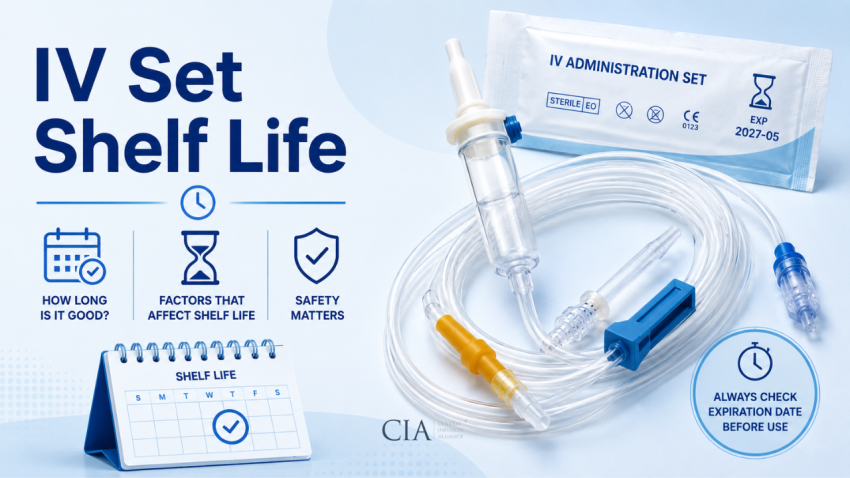
IV Set Shelf Life: How Long is IV Tubing Good for?
IV administration sets are single-use medical devices with a defined shelf life assigned by the manufacturer. Understanding that shelf life, and knowing when to discard tubing regardless of expiration date, is a basic competency for nurses, pharmacists, and procurement teams alike.
The answer involves two distinct but related questions: how long the sealed product remains sterile and fit for use in storage, and how long tubing can safely remain in a patient circuit during active infusion.
What Is the Shelf Life of IV Tubing?
Most unopened primary IV administration sets carry a manufacturer-assigned shelf life of 2 to 5 years from the date of manufacture, provided the packaging remains intact and storage conditions are met. The expiration date is printed on the outer packaging; it is not an arbitrary marketing decision but a validated endpoint based on sterility testing, material stability, and packaging integrity studies required by the FDA.
The FDA requires IV administration sets to undergo 510(k) premarket notification before commercial distribution. That process includes data on sterility maintenance over the stated shelf life. Once the package is opened or breached, the sterility guarantee no longer applies, use the set immediately or discard it.
Shelf life and in-use dwell time are separate concepts. Even a set with two years left on its expiration date must still be replaced according to clinical guidelines once it is in service.
What Factors Affect IV Tubing Shelf Life?
Storage Conditions
Temperature is the primary variable. Most manufacturers specify storage between 59°F and 77°F (15°C to 25°C). Sustained heat exposure above this range accelerates polymer degradation, particularly in PVC tubing, which can release plasticizers (notably DEHP) and lose structural integrity over time. Cold does less damage than heat but extreme low temperatures can make tubing brittle and cause micro-fractures invisible to the naked eye.
Humidity is the second critical factor. High-humidity environments promote mold growth on outer packaging and can compromise peel-seal integrity. Most facilities should maintain storage areas below 70% relative humidity. Direct sunlight exposure is also prohibited, UV radiation degrades polymer materials and the outer packaging barrier.
Package Integrity
The sterility of the contents depends entirely on the packaging barrier. Any compromise, a torn seal, a pinhole, visible moisture inside the pack, or evidence of crushing, renders the set unusable regardless of the printed expiration date. This is true even if the tubing inside appears visually intact. Always inspect packaging before pulling a set from inventory. A compromised seal is a contaminated set.
Tubing Material
Standard IV sets are typically made from PVC (polyvinyl chloride), which is stable under normal storage conditions but sensitive to temperature extremes and UV exposure. Some sets use DEHP-free formulations or polyolefin alternatives, particularly for use with lipids, blood products, or chemotherapy agents. DEHP-free sets may have different shelf-life profiles, verify the manufacturer’s IFU (Instructions for Use) for the specific product.
How Often Should IV Tubing Be Changed? (CDC and INS Guidelines)
The shelf life printed on the package governs storage. Once in use, clinical guidelines govern replacement. These are two distinct timelines, and both matter.
The CDC Guidelines for the Prevention of Intravascular Catheter-Related Infections state that administration sets used for continuous infusions do not need to be replaced more frequently than every 96 hours (4 days), but should be replaced no later than every 7 days. This recommendation applies to standard crystalloid infusions and most IV medications. Replacing sets too frequently adds cost and increases the number of line manipulations, each manipulation is a potential entry point for infection.
There are three important exceptions to the 96-hour rule:
- Blood, blood products, and blood components: Replace the administration set within 4 hours of initiating the infusion, or upon completion of the transfusion, whichever comes first. The 4-hour limit applies because blood products are a growth medium at room temperature.
- Lipid emulsions (fat emulsions): Replace the infusion set within 24 hours of initiating the lipid infusion. Lipids support microbial growth and can degrade PVC tubing over extended contact.
- Propofol: Replace the infusion set every 6 to 12 hours, per manufacturer labeling, or when the vial or syringe is changed, whichever comes first. Propofol is a fat-based emulsion and an exceptional growth medium for bacteria and fungi, including Candida and S. aureus. Multiple outbreak investigations have traced propofol-associated infections to inadequate tubing change practices.
The INS Infusion Therapy Standards of Practice (2021) align broadly with CDC guidance on these intervals and add additional recommendations for intermittent versus continuous infusion sets.
When Should IV Tubing Be Discarded Before Its Expiration Date?
Any of the following findings require immediate discard, even if the expiration date is years away:
- Packaging is torn, punctured, crushed, or shows evidence of moisture penetration
- The seal is broken or partially peeled
- Visible particulate matter, cloudiness, or discoloration inside the tubing
- Tubing shows kinks, cracks, or deformities that could obstruct or alter flow
- The set has been opened and not used immediately, once opened, it cannot be resealed
- The lot number has been recalled by the manufacturer or flagged by the FDA
A simple rule: if there is any doubt about the integrity of the packaging or the set itself, do not use it. The cost of a new set is negligible compared to a catheter-related bloodstream infection.
How Should IV Tubing Be Stored to Maximize Shelf Life?
Following these storage practices will keep inventory within specification through the printed expiration date:
- Temperature: Maintain storage areas between 59°F and 77°F (15°C and 25°C). Do not store in uncontrolled areas such as loading docks, vehicle trunks, or unventilated storerooms.
- Humidity: Keep relative humidity below 70%. Excess moisture degrades packaging seals and outer cartons.
- Light: Protect from direct sunlight and fluorescent UV sources. Store in opaque containers or original shipping cartons.
- Stacking: Do not crush or over-stack packaged sets. Compression can compromise peel seals without producing visible tears.
- Rotation: Use first-in, first-out (FIFO) inventory rotation. Check expiration dates on incoming stock and place newer stock behind older stock.
- Original packaging: Keep in original packaging until point of use. Removing sets from packaging early, even without opening the inner sterile barrier, exposes them to environmental contamination.
What Do Regulatory and Standards Bodies Say About IV Set Expiration?
The FDA regulates IV administration sets as Class II medical devices requiring 510(k) clearance. Manufacturers must validate and label shelf life as part of the clearance process. The FDA also maintains a recall database where clinicians can verify whether specific lot numbers have been withdrawn from service.
The CDC’s catheter-related bloodstream infection (CRBSI) guidelines are the primary clinical reference for in-use set change intervals in the United States. These guidelines were last comprehensively updated in 2011 with partial updates since; always verify the current version on the CDC website.
The Infusion Nurses Society (INS) publishes the Infusion Therapy Standards of Practice, updated most recently in 2021. These standards address not only change intervals but also set selection, priming procedures, and documentation requirements. Compliance with INS standards is widely used as the benchmark for infusion nursing practice.
The Joint Commission and CMS Conditions of Participation do not specify exact tubing change intervals but require facilities to have written policies that reflect current evidence-based guidelines. Facilities citing CDC and INS guidance are generally considered compliant.
References
- https://www.fda.gov/media/78369/download
- https://www.fda.gov/media/72487/download
- https://wwwnc.cdc.gov/eid/article/22/6/15-0376_article
- https://dailymed.nlm.nih.gov/dailymed/drugInfo.cfm?setid=e3105799-a4b6-f3f4-e6e2-b2b29bbdb538
- https://www.cdc.gov/infection-control/hcp/disinfection-sterilization/sterilizing-practices.html
- https://www.ecfr.gov/current/title-21/chapter-I/subchapter-H/part-880/subpart-F/section-880.5440
- https://www.cdc.gov/infection-control/hcp/intravascular-catheter-related-infections/summary-recommendations.html
- https://www.jointcommission.org/en-us/knowledge-library/support-center/standards-interpretation/standards-faqs/000001275
- https://www.fda.gov/regulatory-information/search-fda-guidance-documents/intravascular-administration-sets-premarket-notification-submissions-510k

